


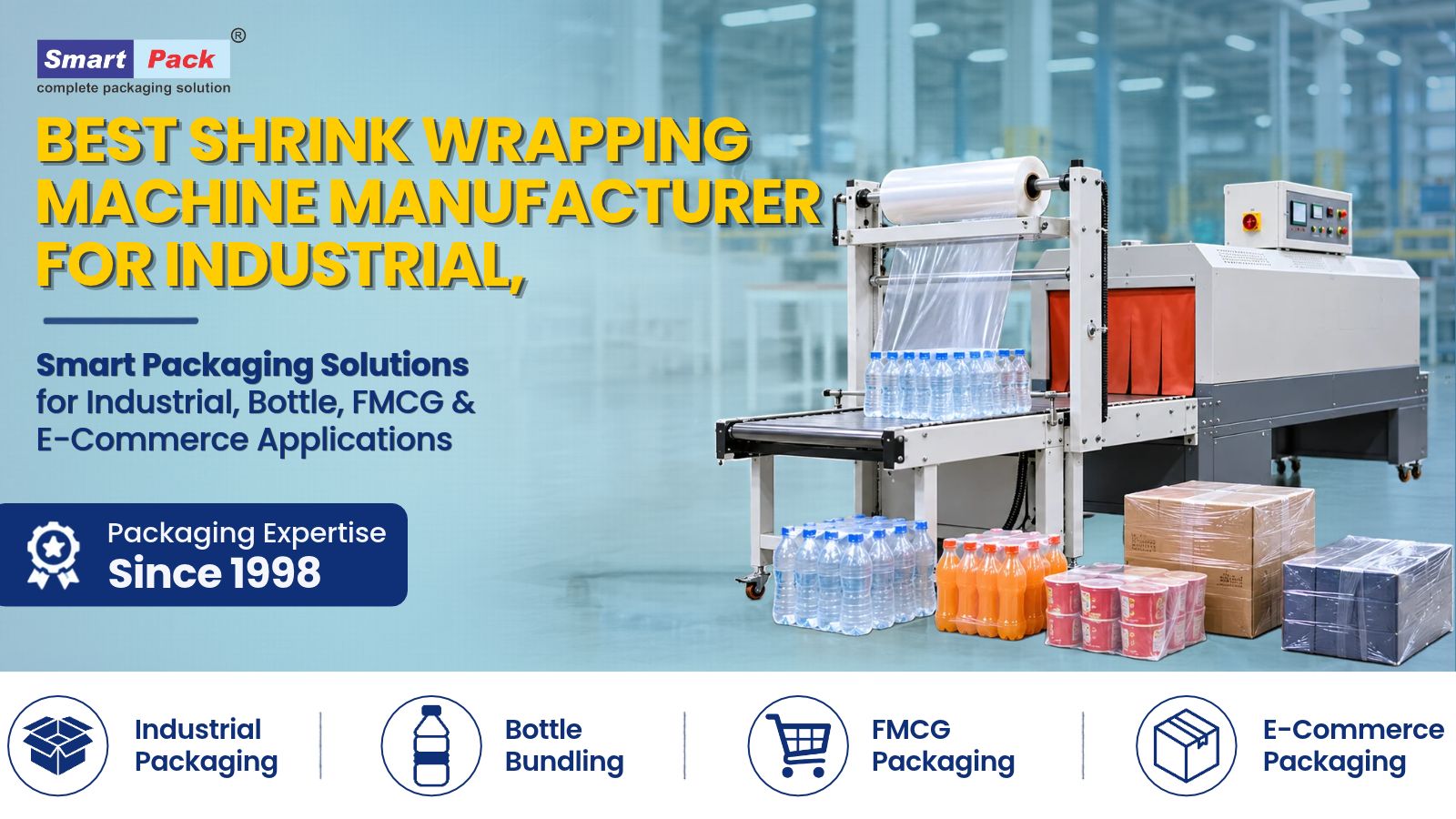
Smart Pack India is a well-known maker and provider of shrink wrapping machines for industrial, bottle, FMCG and e-commerce packaging needs. Our shrink packaging solutions help businesses improve packaging efficiency, product protection and presentation while supporting reliable and consistent packaging operations. Smart Pack provides shrink wrapping machines to various packaging needs from manufacturing units to retail and e-commerce businesses.
Shrink Wrapping Machine Manufacturer | Smart Pack India | Shrink Wrapping Machine For Industrial, Bottle, FMCG & E-Commerce Packaging Solutions
Smart Pack India manufactures packaging machinery for industrial, bottle, FMCG and e-commerce applications. With experience in packaging machinery manufacturing since 1998, the company offers solutions for businesses with different product sizes, packaging formats and production requirements.
-
How it works: Heat makes a special film fit closely around products.
-
Where it is used: Bottles, FMCG products, cartons, industrial components and product bundles.
-
Machine types: Different configurations are available for individual products, multipacks and larger production operations.
-
How to choose: Product dimensions, packaging volume, film compatibility and automation requirements decide the right machine.
-
What to check before buying: Manufacturer experience, installation facilities and after-sales support.
As businesses increase their production and distribution, packaging becomes an important part of their daily operations. Products need to be grouped, secured and prepared for storage, transportation or retail display without slowing down the production process.
Shrink wrapping offers a practical solution for many of these requirements.
Think about three businesses:
-
A beverage manufacturer needs to bundle multiple bottles together.
-
An FMCG company wants to package several consumer products as one promotional pack.
-
An industrial manufacturer covers cartons or groups components before dispatch.
Their packaging requirements are not the same. Product dimensions, packaging volume, film selection and machine configuration all influence the final result.
For businesses looking for a shrink machine manufacturer in India, understanding the available machine options and their applications is a useful starting point.
What Is a Shrink Wrapping Machine?
A shrink wrapping machine is packaging equipment that covers a product or group of products with a special plastic film. When heat is applied, the film contracts and fits closely around the items, creating a compact package.
The process can be used for individual product wrapping as well as multipack packaging.
Common applications include:
-
Grouping bottles and beverage containers.
-
Packaging consumer goods and FMCG products.
-
Wrapping cartons and product boxes.
-
Bundling promotional product combinations.
-
Covering selected industrial products before dispatch.
How Does a Shrink Wrapping Machine Work?
The basic process runs in five steps:
-
Product Placement: Products are positioned manually or fed automatically into the machine. For multipack applications, the required number of items is arranged together.
-
Film Wrapping: Shrink film is fed around the product or product group according to its dimensions.
-
Sealing and Cutting: The film is sealed and cut to create an enclosed wrapping around the product.
-
Heat Shrinking: The wrapped product passes through a heat shrink tunnel, where controlled heat causes the film to contract around it.
-
Cooling and Final Packaging: The film cools and retains its shape, leaving the product ready for storage, handling or dispatch
NOTE: The final packaging quality depends on appropriate film selection, sealing, and temperature settings.
Looking for a shrink wrapping machine for your business?
Explore packaging machinery solutions at Smart Pack India and discuss your requirements with the team.
What Can You Pack Using a Shrink Wrapping Machine?
Shrink wrapping machines are used across several industries because they can accommodate different products and packaging formats. The actual applications depend on the machine configuration, product dimensions and film compatibility.
|
Industry |
Products commonly packed |
Example |
|
Bottle and Beverage |
Mineral water, soft drink and juice bottles, plastic beverage containers, selected glass bottle packs |
A beverage manufacturer groups six or twelve bottles into one pack instead of handling each bottle individually during distribution. |
|
FMCG |
Shampoo and personal care products, soap and detergent packs, cosmetic boxes, household cleaning products, promotional combinations |
A personal care brand offering shampoo and conditioner together holds both products in one package. |
|
Industrial |
Machine components, hardware products, electrical accessories, industrial supplies, manufactured parts, selected equipment and assemblies |
The machine is selected according to the product's weight, dimensions and required packaging arrangement. |
|
E-Commerce and Carton |
Individual product cartons, retail product boxes, multiple-item bundles, promotional kits |
An online business selling a set of three products holds the individual boxes together before dispatch. |
|
Food and Others |
Packaged food containers, food trays, bakery product packs, multipacks of packaged food items |
Used for selected applications when the film and machine are suitable for the intended product. |
|
Pharmaceutical |
Medicine cartons, syrup bottles, tablet boxes, capsule packs, medical product boxes |
A pharmaceutical manufacturer groups multiple medicine cartons into one pack for easier handling and distribution. |
Types of Shrink Wrapping Machines Used in Different Industries
Different products require different wrapping arrangements. A business packaging individual cartons may need a different machine from a beverage manufacturer bundling bottles. Shrink wrapping machines broadly fall into three types, based on how much of the process is handled by the machine.
1. Manual Shrink Wrapping
In manual shrink wrapping, the operator handles the entire process: placing the film around the product and applying heat by hand.
-
Machine in this category: Heat Gun. A handheld machine that directs heat onto the film, causing it to contract around the product.
-
Best suited for low packaging volumes, occasional or small-scale packing, and businesses that want a basic, low-investment starting point.
2. Semi-Automatic Shrink Wrapping
Semi-automatic machines combine manual product handling with machine-assisted wrapping, sealing or heating. The operator positions the products or performs certain steps, while the machine handles the rest.
Machines in this category:
-
Shrink Tunnel: The wrapped product passes through the tunnel, where controlled heat shrinks the film around it.
-
L-Sealer: An L-shaped sealing mechanism closes shrink film around a product. Depending on the setup, the product then passes through a shrink tunnel.
-
Chamber Type Shrink Machine: The product is placed in the machine’s heating chamber, where the film is shrunk around it.
-
Best suited for small and medium manufacturing units, moderate packaging volumes, product boxes and cartons, cosmetic packaging, consumer goods, and printed materials and stationery. It is a practical choice for businesses that want machine-assisted packaging without investing in a fully automated line.
3. Automatic Shrink Wrapping
Automatic machines are designed for businesses that require a more automated packaging process. Depending on the configuration, product feeding, film wrapping, sealing and movement through the shrink tunnel can be integrated into a continuous operation.
Machines in this category:
-
Heavy Duty Shrink Tunnel Machine: Built for heavy-duty, continuous shrinking operations.
-
Fully Automatic L-Sealer with Tunnel: Handles sealing and shrinking as one integrated process with minimal manual involvement.
-
Best suited for high-volume FMCG production, beverage packaging lines, large-scale manufacturing and regular carton packaging operations. They are worth considering when production volumes justify automation and businesses want to reduce manual involvement in repetitive packaging tasks.
Shrink Wrapping Machine Buying Checklist
Before finalizing a shrink wrapping machine, go through this checklist to make sure the equipment matches your actual packaging requirements.
-
Product Details: Have you noted the product dimensions, weight, shape and packaging arrangement?
-
Production Capacity: Have you calculated the number of products you need to pack per hour or shift?
-
Machine Configuration: Have you identified whether a semi-automatic or automatic machine is more suitable?
-
Film Selection: Have you confirmed the required shrink film type, thickness and machine compatibility?
-
Packaging Format: Do you need individual wrapping, multipack bundling or carton wrapping?
-
Machine Specifications: Have you checked the sealing area, tunnel dimensions, conveyor setup and operating requirements?
-
Installation: Does the manufacturer provide installation, commissioning and operator guidance?
-
Maintenance Support: Are spare parts, servicing and technical assistance available?
-
Future Requirements: Can the selected machine accommodate your expected production growth?
-
Quotation and Warranty: Have you reviewed the machine price, warranty coverage and additional operating costs?
Buying Tip: Share product photographs, dimensions, packaging samples and expected production volume with the manufacturer before requesting a quotation. This makes it easier to identify a suitable machine configuration.
Why Choose Smart Pack India as Your Shrink Wrapping Machine Manufacturer?
|
Strength |
What it means for you |
|
Wide experience |
Filling, weighing, sealing, pouch packing, vacuum packaging, shrink wrapping, strapping, labelling and coding. |
|
Industry understanding |
Beverage, FMCG, food and industrial needs differ, so the application guides the machine. |
|
Scale options |
Semi-automatic and automatic solutions. |
|
In-house manufacturing |
Requirements assessed for your product, format and layout. |
|
After-sales support |
Installation, technical assistance and spare parts across India. |
Find the Right Shrink Wrapping Solution with Smart Pack India
The right shrink wrapping machine depends on the products you manufacture and how you plan to package them. A machine suitable for bundling beverage bottles may not be the right choice for wrapping industrial components or individual cartons.
Before investing, consider your product dimensions, packaging format and production volume. Discussing these requirements with an experienced manufacturer can help you identify a suitable machine configuration.
With packaging machinery manufacturing experience since 1998, Smart Pack India works with businesses across different industries to explore packaging solutions suited to their operations.
FAQ's
A shrink machine is used to cover products or groups of products with heat-shrinkable film. It is commonly used for bottle multipacks, FMCG products, cartons, consumer goods and selected industrial items.
Shrink wrapping machines are used in beverage, food processing, FMCG, cosmetics, pharmaceuticals, electronics, manufacturing, retail and e-commerce-related packaging operations
Yes. Shrink wrapping machines are widely used to bundle plastic and glass bottles into multipacks. The number of bottles per pack and machine configuration depend on bottle dimensions and the required packaging arrangement.
These machines can handle bottles, cartons, cosmetic boxes, household goods, packaged food products, hardware components, electrical accessories and promotional product bundles. Suitability depends on the machine design and film selection.
There is no single film suitable for every application. POF is commonly used for retail product packaging, PVC is used in selected shrink applications, and PE is often used for multipack bundling. The appropriate choice depends on the product and machine compatibility.
A semi-automatic machine requires operator involvement in certain stages, such as product positioning. An automatic machine can integrate more packaging operations into a continuous process. The right option depends on production volume and automation requirements.
 Chat With Us