


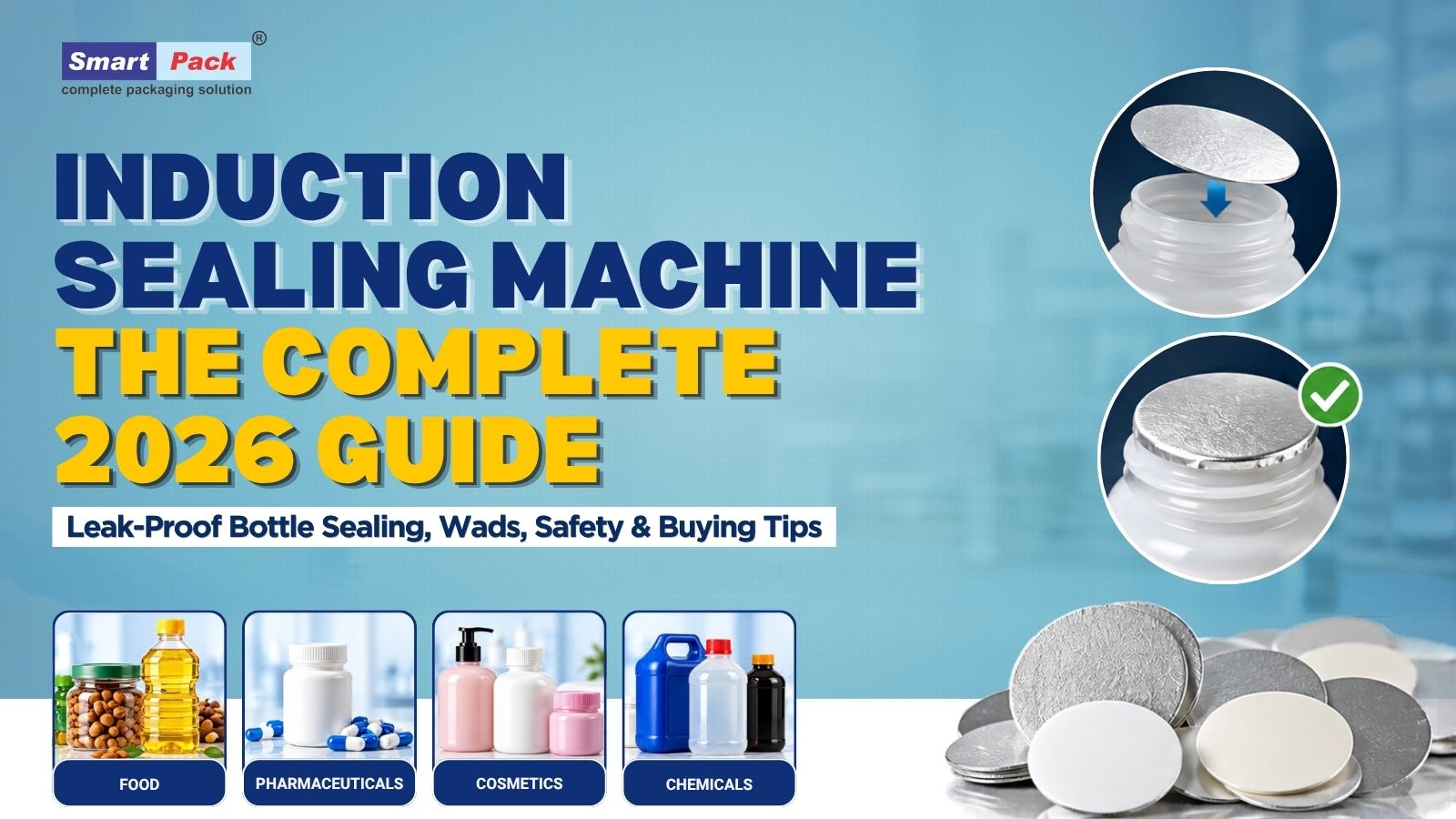
Remember the last time you opened a box and found a leaking bottle inside? No one likes that. Now you have an angry customer, wasted product, a refund claim and potentially a lost customer.
Induction Sealing Machine (इंडक्शन सीलिंग मशीन): The Complete 2026 Guide to Leak-Proof Bottle Sealing
An induction sealing machine helps stop this. It sticks a thin foil layer over the mouth of the bottle. This closes the bottle tightly, so nothing leaks out, and the customer can easily see if anyone has opened it before. The whole thing takes just a few seconds.
But the machine is not the only thing that matters. A good seal also depends on the bottle, the cap, the foil liner inside the cap, the machine settings and how your production line runs.
In this guide, we will walk you through:
-
How an induction sealing machine works, step by step
-
Which induction sealing wad suits your bottles
-
How handheld, semi-automatic and automatic machines differ
-
How to fix the most common sealing problems
-
Safety practices every operator should follow
-
What to check before you buy a machine in 2026
Let us break it down from the start.
What Is an Induction Sealing Machine?
An induction sealing machine is a packaging machine that uses electromagnetic induction to heat a foil liner inside a bottle cap and bond it to the rim of the container. You may also hear it called an induction cap sealer or a foil sealing machine.
The best part? The sealing head never touches the foil. It works right through the closed cap, so you can seal bottles after they have been filled and capped.
Which Industries Use Induction Sealing?
Almost anyone who sells a product in a bottle or jar can benefit:
-
Food and beverages: sauces, ketchup, honey, edible oils, ghee, spices and dairy products
-
Pharmaceuticals and nutraceuticals: tablets, capsules, syrups and supplements
-
Cosmetics and personal care: creams, lotions, shampoos and hair oils
-
Lubricants and industrial liquids: engine oils, coolants and adhesives
-
Agrochemicals and household chemicals: pesticides, fertilisers, cleaners and disinfectants
The right liner and machine setup will depend on your product, container material, closure design and sealing requirements.
Need help choosing?
Explore the range of induction sealing machines at Smart Pack India or contact our team with your bottle and cap details. We will recommend a machine and wad combination and arrange a sealing trial, for your production line.
Why Use Induction Sealing? The Key Benefits
-
Leak prevention: A properly formed seal stops spills during storage, handling and long-distance transport.
-
Tamper evidence: A broken or missing foil tells customers at a glance if the pack has been opened.
-
Longer shelf life: Depending on the liner, the seal adds a barrier against moisture, oxygen and contaminants, which helps keep the product fresh.
-
Lower losses: Fewer leaks mean fewer returns, damaged cartons and customer complaints.
-
Fast, clean and non-contact: The seal forms in a fraction of a second, and the head never touches your product.
Good to know: An induction seal works together with a properly fitted cap. It does not replace one. Always test the complete closure system for your application.
How Does an Induction Sealing Machine Work?
Here is the simple version. The machine creates a high-frequency electromagnetic field that heats the aluminium foil inside the cap liner. That heat melts the liner's polymer layer, which bonds to the bottle rim and forms the seal.
The Induction Sealing Process, Step by Step
-
Fill the container. Fill the bottle with your product and keep the rim clean and dry. Product residue on the rim is one of the leading causes of weak seals.
-
Fit the lined cap. Apply a cap with the correct induction wad and tighten it to the torque recommended by the closure manufacturer.
-
Position the container. Place the capped bottle under the sealing head. On conveyor systems, bottles pass through the sealing zone automatically.
-
Generate the electromagnetic field. The sealing head induces eddy currents in the aluminium foil, which heats it rapidly.
-
Bond the liner to the bottle. The heat activates the liner's heat-seal layer, which fuses to the container rim.
-
Let it cool and inspect. As the bond cools, the seal sets. Check sample bottles for complete, even bonding and correct cap fit.
Main Components of an Induction Sealing Machine
|
Component |
What it does |
|
Sealing head (coil) |
Generates the electromagnetic field that heats the foil liner |
|
Power supply and control system |
Converts mains power to high frequency and regulates output |
|
Conveyor |
Carries bottles through the sealing zone (automatic models) |
|
Height adjustment |
Sets the gap between head and cap for different bottle sizes |
|
Control panel |
Lets operators adjust power and speed and view faults |
|
Cooling system |
Keeps the coil and electronics within safe temperature (air or water cooled) |
Handheld models are simpler and have no conveyor.
Induction Sealing Wads: Types, Layers and How to Choose
If the machine is the engine, the wad is where the real sealing happens. An induction sealing wad (also called an induction liner or seal liner) is the multi-layer disc fitted inside the cap that becomes the foil seal.
A typical wad has these layers:
-
Backing layer: pulpboard or foam that cushions the seal and stays in the cap (two-piece wads)
-
Wax layer: releases the backing from the foil when heated (two-piece wads only)
-
Aluminium foil: the layer that heats up in the electromagnetic field and acts as a barrier
-
Heat-seal polymer: melts and bonds to the bottle rim
One thing to remember: the heat-seal layer must match your container material. A liner made for PET may not bond properly to HDPE, PP or glass.
One-Piece vs Two-Piece Induction Wads
|
Feature |
One-piece wad |
Two-piece wad |
|
Construction |
Foil and heat-seal layer only, no separate backing |
Foil seal plus a backing bonded with wax |
|
After sealing |
The whole liner bonds to the bottle |
Wax melts; foil bonds to the bottle, backing stays in the cap |
|
After opening |
Nothing is left in the cap |
Backing in the cap acts as a reseal gasket |
|
Resealing |
Relies on the cap's own sealing design |
Good reseal after each use |
|
Best for |
Single-use packs, cost-sensitive lines, caps with built-in seal rings |
Products opened and closed repeatedly, such as oils, sauces and supplements |
How to Choose the Right Induction Sealing Wad
Run through these points before you order liners in bulk:
-
Container material: Confirm compatibility with PET, HDPE, PP, glass or your specific material.
-
Cap size: The wad diameter must match the inside of the cap and cover the sealing area fully.
-
Product compatibility: Oils, solvents, acids and alcohol-based products can attack some liners. Ask for a chemical-resistant grade if needed.
-
Barrier needs: Choose a thicker foil or special construction for products sensitive to moisture or oxygen.
-
Opening style: Decide between a standard seal, an easy-peel seal with a tab, or a two-piece wad for resealing.
-
Machine compatibility: Confirm that the liner works within your machine's power and speed range.
Pro tip: Run a trial with your actual bottle, cap, product and machine before placing a large order.
Explore our range of induction sealing machines and find the right solution for your packaging requirements.
Types of Induction Sealing Machines
The right machine depends on your production volume, container sizes, floor space and how much automation you want.
|
Type |
How it works |
Best for |
|
Handheld |
Operator holds the sealing head over each capped bottle |
Start-ups, trial batches, low volumes, frequent product changes |
|
Semi-automatic |
Some steps automated; operator still places or removes bottles |
Growing businesses not yet ready for a full line |
|
Automatic (conveyor) |
Bottles pass under a fixed head on a conveyor, no manual positioning |
High-volume, continuous production lines |
Handheld Induction Sealing Machine
Compact, portable and easy on the budget. Seal quality depends on the operator holding the head steady for the right amount of time, so it suits smaller runs best.
Semi-Automatic Induction Sealing Machine
This one reduces manual effort while keeping an operator in the loop. Automation levels vary by model, so confirm exactly which operations are automated before you buy.
Automatic Induction Sealing Machine
Built to integrate with your filling and capping line, it delivers consistent, repeatable sealing at speed. Just make sure its capacity matches your actual line speed and bottle range.
Common Induction Sealing Problems and How to Fix Them
Most sealing faults come down to a mismatch between power, speed, cap torque and liner. Use this table as your first check.
|
Problem |
Likely causes |
How to fix it |
|
No seal or weak seal |
Power too low, conveyor too fast, head too high, wrong liner for the bottle material |
Increase power or reduce speed, lower the head, confirm liner compatibility |
|
Burnt, scorched or wrinkled foil |
Power too high, conveyor too slow, bottle stopped under the head |
Reduce power or increase speed; never let bottles stall in the sealing zone |
|
Partial seal (gaps around the rim) |
Uneven or damaged rim, low cap torque, cap fitted at an angle |
Inspect bottle neck finish, set correct torque, check capper alignment |
|
Foil hard to peel or tears |
Over-sealing, wrong liner grade |
Lower the heat; use an easy-peel or tabbed liner |
|
Backing stuck to foil (two-piece wad) |
Too little heat to melt the wax layer |
Increase power slightly or slow the conveyor |
|
Leakage after sealing |
Product on the rim, damaged foil, insufficient cap torque |
Clean rims before capping, inspect liners, recheck torque |
|
Deformed cap or bottle neck |
Excess heat transferred to the closure |
Reduce power or dwell time; check cap material suits induction sealing |
Quick tip: Change one setting at a time and record the result. A simple peel test and a squeeze or inversion test on sample bottles every shift will catch most problems early.
Induction Sealing Machine Safety Tips
A safe line is a productive line. Keep these habits in place:
-
Keep metal away from the sealing head. Rings, watches and tools can heat up quickly in the electromagnetic field.
-
Check medical devices. Operators with pacemakers or other implanted devices should consult a doctor and the machine manufacturer before working near the sealing head.
-
Ensure proper earthing. Install the machine on a correctly earthed supply with a stable voltage.
-
Do not block cooling vents. Keep air vents clear and, on water-cooled models, check coolant flow regularly.
-
Switch off before maintenance. Disconnect power before cleaning, adjusting or servicing the machine.
-
Use guards and emergency stops. Keep conveyor guards in place and make sure the emergency stop is easy to reach.
-
Train every operator. Make sure staff understand the settings, fault indicators and the manufacturer's safety instructions.
Induction Sealing vs Other Bottle Sealing Methods
Each sealing method solves a different packaging problem, so induction sealing is not the right answer for every product.
|
Method |
How it works |
Main consideration |
|
Induction sealing |
Electromagnetic heat bonds a foil liner to the rim through the closed cap |
Needs compatible liners, closures and correct settings; gives the strongest leak and tamper protection |
|
Pressure-sensitive liner |
An adhesive layer sticks to the rim when the cap is tightened |
No machine needed, but a weaker seal; best for dry products |
|
Conventional cap only |
The cap alone closes the container |
Lowest cost, but no inner seal or tamper evidence |
|
Conduction (direct heat) sealing |
A heated plate presses foil onto the open container, before capping |
Suits cups and wide-mouth tubs; requires direct contact and an extra step |
Choose based on your product, container design, barrier needs, tamper-evidence requirements and production process.
Conclusion
A dependable, leak-proof seal comes from three things working together: the right induction sealing machine, a compatible sealing wad, and correctly tuned settings. Get these right and you cut leakage, protect your product and give customers visible proof that nobody has tampered with it.
FAQ's
It bonds a foil liner to the mouth of a bottle or jar to prevent leakage, provide tamper evidence and protect the product from contamination
Yes. It works with PET, HDPE, PP and other compatible plastics, provided you use a liner made for that specific material.
Yes, with liners designed for glass. Results depend on the glass finish, liner construction, closure and machine setup, so run a trial first.
Generally no. Metal caps absorb the electromagnetic energy and heat up instead of the foil. Use plastic caps unless the supplier confirms a special solution.
It is a multi-layer liner fitted inside the cap, usually with an aluminium foil layer and a heat-seal layer, plus backing or barrier layers depending on the design
 Chat With Us